
1,293 Days
When an important photograph stumbles across your path

You’re interviewed for a podcast. The host asks you to share three photographs—even though it’s all on audio—and promises to post the pictures to his Instagram when the episode goes live.
All three photographs you select are important. But it’s the one of your father that truly matters. Possibly more than any of the others in the sixteen terabytes you’ve collected over the years.
It’s taken on August 1, 2022.
You’d flown in to take care of your parents’ house after the death of your mother, and to attend her funeral. You’d driven the two hours from London through heavy traffic, and upon arrival you’d found your father fragile but not broken, surrounded by a flotsam of papers scattered in his restlessness, trying to make sense of what had happened.
Your sister is there, helping him get his things in order. She will take him south later that day, leaving you to empty the house and sort through your mother’s papers. You will head towards London in two days for the funeral. Your father won’t be coming back. The plan is for him to live close to your sister.
In spite of all this, one thing centres you: photography. Even in a moment like this you remain a photographer. You know that photographs matter. Always. No matter the situation.
So, amidst the disorder of two lives—one lost, the other heading for an unknown destination—you instinctively look for the moments, ready to react.
It’s not long after your arrival. After coffee, after a brief survey of how the land lies, you see a moment.
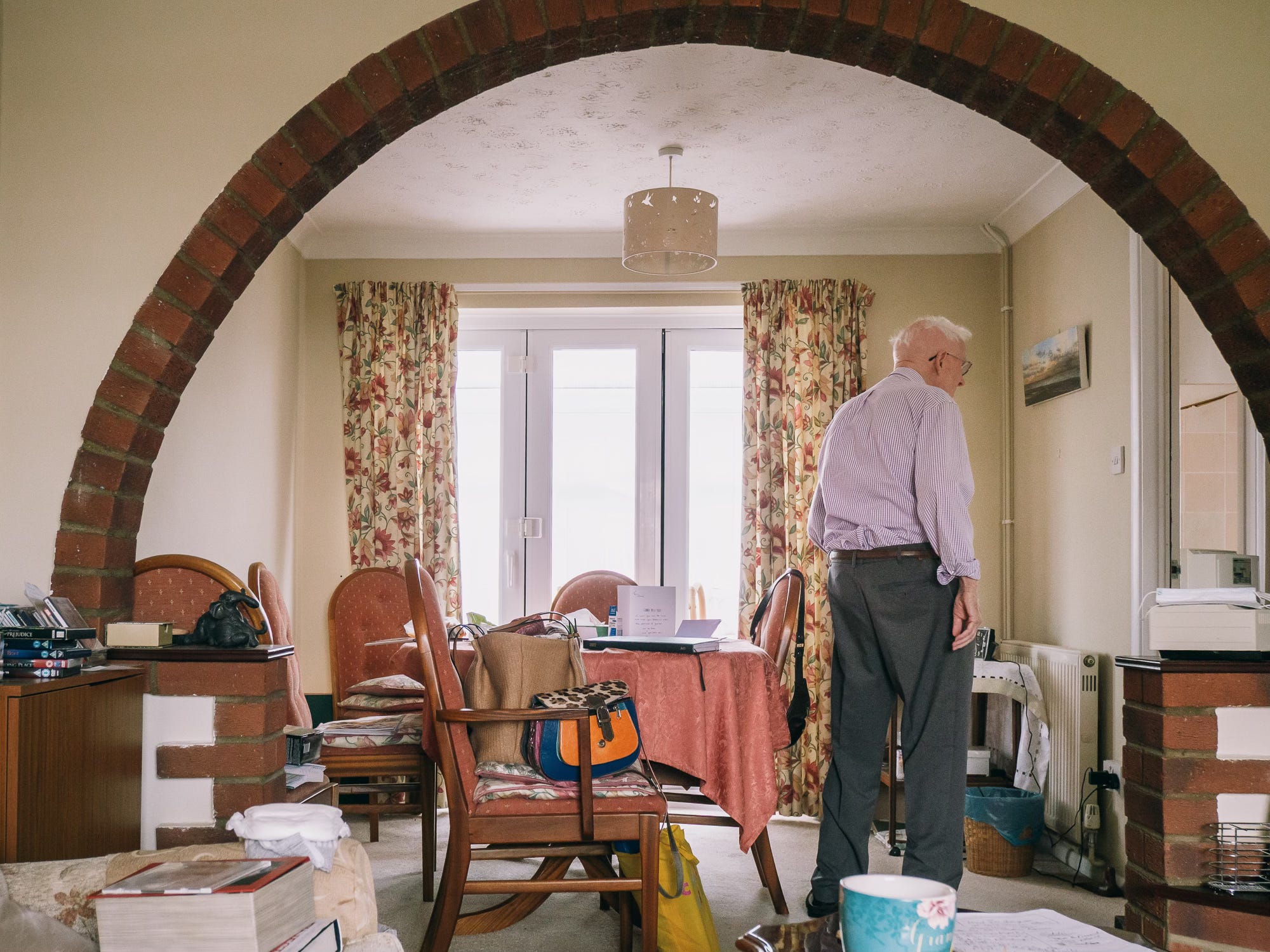
You reach for your camera and technique takes over. The interior photographer in you checks that the lines are straight. You position your father to the right of the frame, instinctively following the rule of thirds. You notice that the light from the conservatory window falls gently, catching him in its soft glow, highlighting the contours of his slightly hunched back.
You quietly take the photo, then carry on. There are things to be seen to. Your sister is telling you they must leave no later than two because of the roads.
1,293 days have passed since this moment. You can’t recall if you crouched down or held the camera just below waist height. But from reading the photograph now, you suspect you were crouching, the camera held steady, straining to keep the lines straight. This is the height you’d be at if you were photographing for a real estate listing.
But this photograph is more important than the thousands you’ve taken of rooms in other people’s houses.
This is the last day your father will stand in this room.
You see it now: your father, perhaps fifteen kilos lighter than when you saw him six weeks earlier, shrunk in his clothes. His posture hunched, not the strong figure he was the last time you were there. Since your mother died, each wave of grief has chipped away at him.
But there is no grief in this picture. There is confusion, there is bewilderment, but he’s still making an effort. Still wearing smart slacks. Still wearing a shirt. And although you can’t see it in the picture, you know there’s a pen in his breast pocket, still at the ready.
With his back turned towards you, you can’t see his face. From his stance and implied gaze, you think he’s talking to your sister. Or perhaps listening to her instructions. Then again, he could just be watching.
You study the picture more closely now, seeing things you don’t remember seeing before. The cup in the foreground that possibly says “Grandma.” The condolence card in the middle of the dining table, in the middle of the frame.
Condolence cards were important to him. You remember that. He would have held it in his dry hands and re-read it several times. He’d already told you who had been in touch. Several times.
And there on the chair—the one he would have sat in—is your sister’s handbag, its gaudy orange, blue and leopard skin clashing with the muted furnishings of the room.
Over the next nine days you will take many more photographs. Photos of letters, of pens, of your mother’s lifetime of diaries, of scribbled lines from people long since passed. You will photograph two beds piled with photo albums. Photographs of photographs. Boxes packed in a garage.
You’ll head south for the funeral, sit with your father, introduce him to the world of selfies as you talk through the old days, his memories of Hills Road in Cambridge.
But the photograph that lingers is your father in his living room, his back turned, looking towards another room.
On the podcast you talk about how lucky you were that the light was right. You focus on technique, on the need to always be on the lookout for a moment, on the need to be able to react. Eventually the conversation moves on to the other photographs and you repeat much of the same: straight lines, look for the light, look for the moment.
But now, afterwards, as you click through to the photograph and look again you think through the frame; you know how lucky you were to see your father in his home for the very last time.
You also realise in hindsight that you photographed a different kind of room: a waiting room, not a living room.
After the frame is taken, he’ll step through the doorway to the kitchen. In no more than two hours he’ll drive away to another town, another house, another room.
In two days’ time he’ll attend his wife’s funeral.
And in ten days’ time, a week after your mother’s funeral, this photograph will testify to time’s relentless melt.
He will be dead.
o jon! o man! this is beautiful + powerful + poignant.
+ so familiar. among other things, i have photographed photos, notes, in situ, osv to help retain how things were... a lot! have been backing them up. eventually my backups will be backed up [i feel no shame or embarrassment about this]. many printed out [off my phone].
you + i have mentioned before about th power of photographs. i still believe photography is one of man's best, most important inventions.
i am glad you took + have that photo. + other photos.
i am sorry about your losses, jon x
you are so good with images + words, jon. thank you for sharing here + with th world.
"...fragile but not broken... each wave of grief has chipped away at him... towards another room... he'll step through..."
+ so, eventually, will we all.
x
So beautifully written Jon. I am glad you have this photograph. Love is so powerful and yet so painful too at times. Sending you love ❤️